Supported local records
Stored diagrams, electron counts, geometry, angles, hybridization, molar mass and composition.
Enter a molecule or ion to generate its Lewis structure and check the key answer details: valence electrons, lone pairs, formal-charge guidance, VSEPR geometry, bond angle and hybridization.
Educational reference only. Verify important answers with course materials. Unsupported inputs may show a PubChem 2D structure reference, which is not necessarily a Lewis dot diagram.
Select a supported example to generate its stored diagram and molecular properties.
Browse all supported molecules and detailed guides →The generator gives you a result. The illustrated guide shows why that result is correct, one electron move at a time.
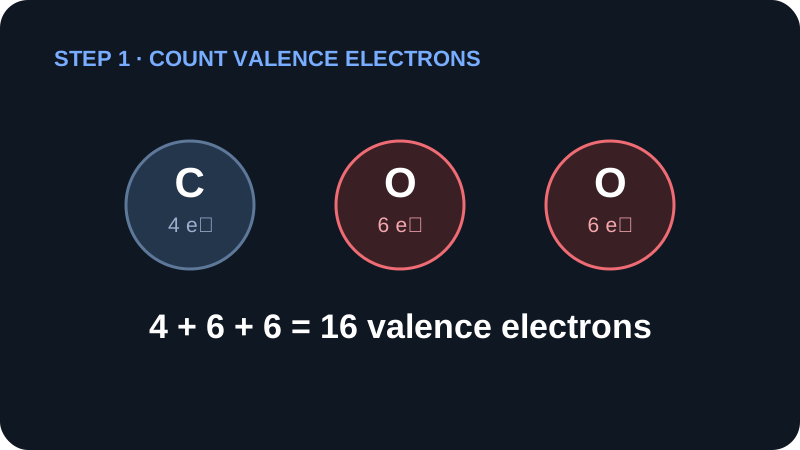
Fix the total before drawing so dots and bonds cannot appear from nowhere.
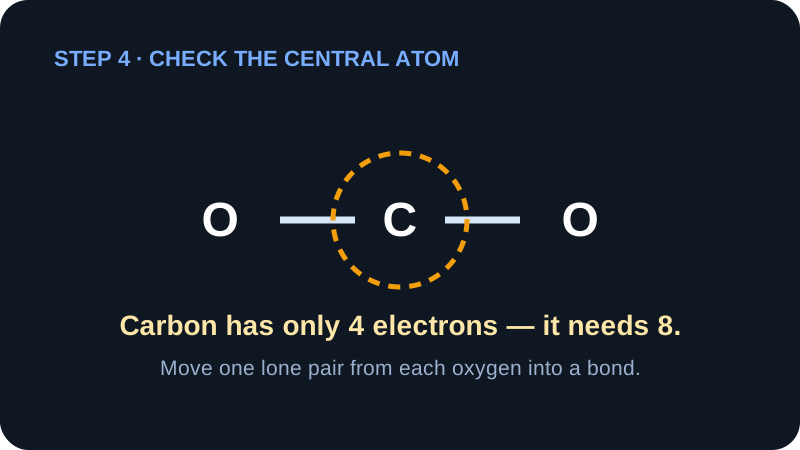
Using all electrons does not guarantee a valid structure. Verify octets.
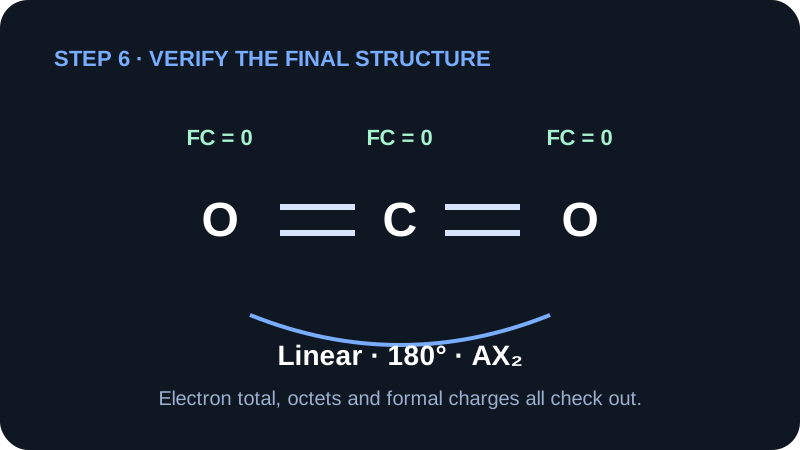
Finish by confirming electron totals, formal charges and VSEPR shape.
Follow CO₂ from the periodic table to the final O=C=O structure, then apply the same method to NH₃ and H₂O.
Each guide explains electron counts, connectivity, lone pairs, formal charges, resonance and molecular geometry for one compound.
Follow an illustrated method for electron counting, skeleton selection, lone pairs, multiple bonds and final checks.
quizWork through randomized formulas, reveal hints and compare your drawing with the detailed answer guides.
balanceLearn the formal-charge equation, compare candidate structures and draw resonance contributors correctly.
electric_boltUnderstand brackets, total charge, electron addition or removal and the limits of molecular Lewis diagrams.
hubReview carbon valence, condensed formulas, multiple bonds, functional groups and formula ambiguity.
view_in_arSee why a Lewis diagram is 2D and how VSEPR converts electron domains into a three-dimensional molecular shape.
For reviewed and supported compounds, the generator combines the Lewis diagram with the electron count, molecular geometry, bond angle, hybridization and a direct step-by-step guide.
If a formula is not in the reviewed Lewis library, the tool clearly labels any external 2D reference so it is not confused with a Lewis dot structure.
Stored diagrams, electron counts, geometry, angles, hybridization, molar mass and composition.
Save the displayed Lewis structure as a PNG or SVG file directly in the browser.
Available records include VSEPR geometry names and representative bond angles.
Unsupported, ambiguous and model-dependent cases are documented instead of being presented as guaranteed answers.
Move from a broad chemistry question to a focused calculator, comparison or practice page.
Compare charge, electron counts, resonance and reviewed ion guides.
sync_altUnderstand contributors, formal charges and the resonance hybrid.
errorReview incomplete octets, radicals and expanded-valence models.
calculateBuild the electron budget for simple molecules and ions.
balanceCalculate FC from valence, nonbonding and bonding electrons.
assignmentPractice common structures and reveal checked answer summaries.