Home How to draw Lewis structures
Illustrated Lewis structure generator with steps
How to Draw Lewis Structures Step by Step
Learn the method with pictures instead of memorizing a finished answer. The CO₂ example below shows what changes at every step, why the change is needed and how to check the final structure.
Prepared by the LewisStructureGenerator.org editorial team · Reviewed July 16, 2026 · Methodology · Limitations
Lewis Structure Steps Use this order for most introductory problems
Step 1 Count valence electrons
Step 2 Choose the central atom
Step 3 Draw single bonds
Step 4 Complete outer octets
Step 5 Fix the central atom
Step 6 Check charges & geometry
Symbols 1. Electrons 2. Skeleton 3. Lone pairs 4. Central atom 5. Double bonds 6. Verify
First, understand the drawing language
A Lewis structure is an electron-accounting diagram. Every dot or line represents electrons that must be included in the total count.
The rule that prevents most mistakes: keep a running electron total. Never add a dot or bond without knowing where those electrons came from.
• •
Lone pair Two nonbonding electrons on one atom
—
Single bond One shared pair, or two electrons
=
Double bond Two shared pairs, or four electrons
[ ]⁻
Ion brackets Show the charge of the complete structure
The six-step method in one sentence
Count electrons → choose the skeleton → add single bonds → complete terminal octets → fix the central atom → verify formal charges and geometry.
Electron total Correct connectivity Terminal octets Central atom Formal charges Resonance
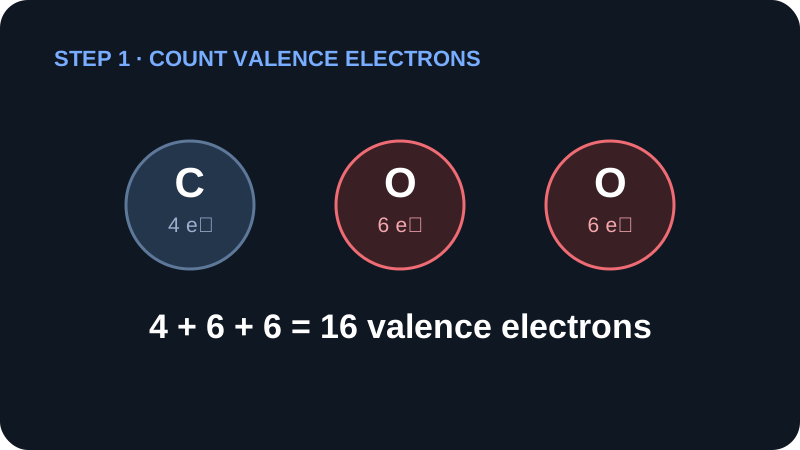
Start with a fixed electron budget: CO₂ has 16 valence electrons. 1
Count all valence electrons Use periodic-table group numbers for main-group elements. Add the contribution from every atom before drawing any bonds.
C: 4 + O: 6 + O: 6 = 16 e⁻Why this matters: the final drawing must contain exactly 16 electrons—no more and no fewer.
For ions: add one electron for each negative charge and subtract one for each positive charge.
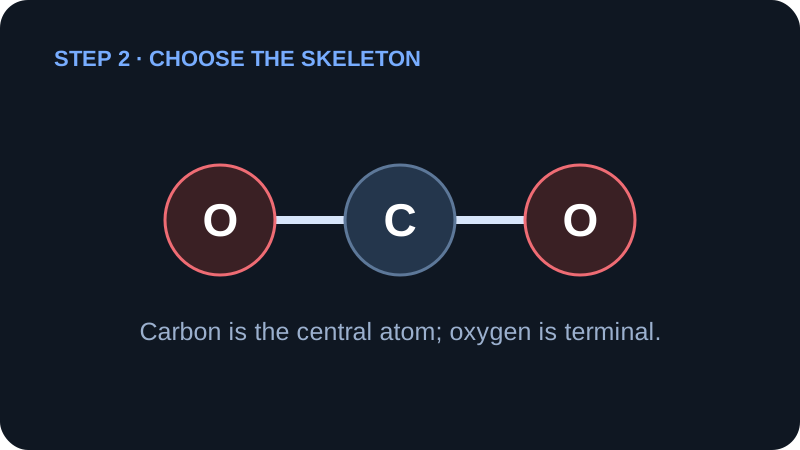
Carbon is less electronegative than oxygen and can form several bonds, so it belongs in the center. 2
Choose the atom arrangement Put the least electronegative suitable atom in the center. Hydrogen is always terminal, and halogens are usually terminal.
O — C — OWhy carbon is central: it can bond to both oxygen atoms and normally forms four bonds.
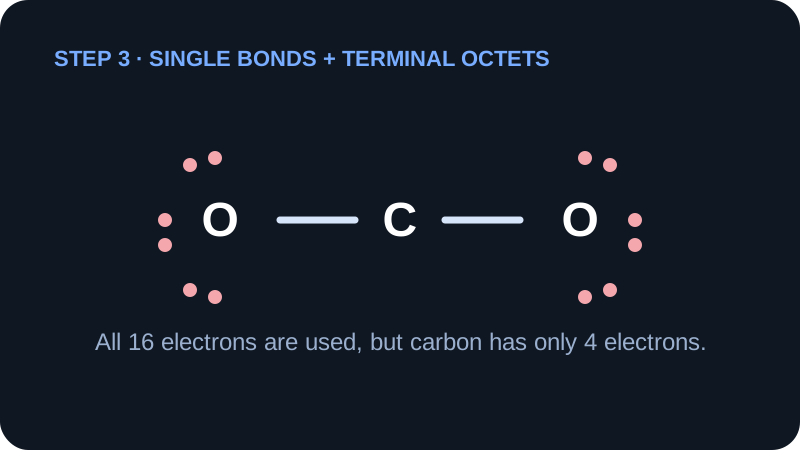
Two single bonds use 4 electrons. Completing both oxygen octets uses the remaining 12. 3
Add single bonds and fill terminal octets Connect the skeleton with single bonds first. Then give terminal atoms enough lone pairs to complete their octets.
16 total − 4 in bonds = 12 electrons for lone pairsWork outside in: finish terminal atoms before placing leftover electrons on the central atom.
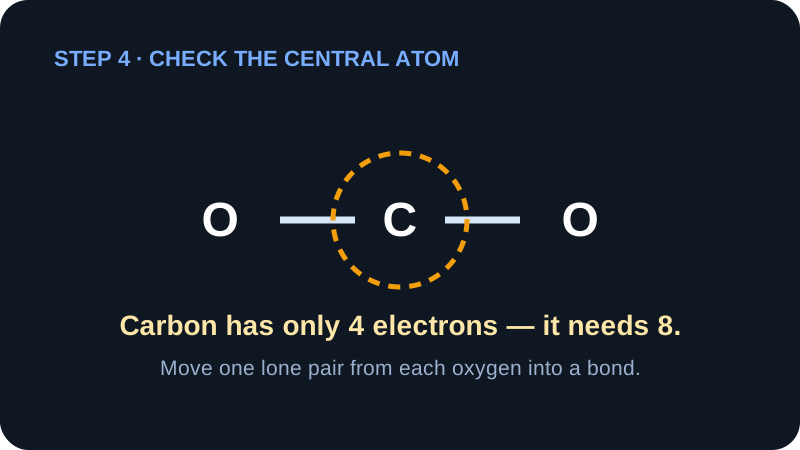
The electron total is correct, but carbon still does not have an octet. 4
Inspect the central atom Count the electrons surrounding carbon. Two single bonds provide only four electrons, so carbon is short of an octet.
2 bonds × 2 electrons = 4 electrons around carbonCommon mistake: stopping because all available electrons were used. Electron count alone is not enough; check octets too.
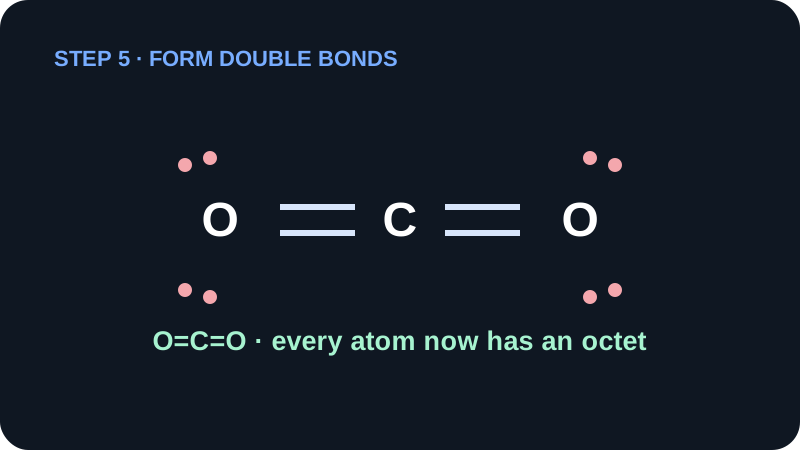
One lone pair from each oxygen becomes a second shared pair, creating O=C=O. 5
Form multiple bonds when needed Convert one lone pair from each oxygen into a bonding pair. This does not change the total number of electrons—it only changes where they are located.
O–C–O → O=C=OResult: carbon now has eight surrounding electrons, and each oxygen still has an octet.
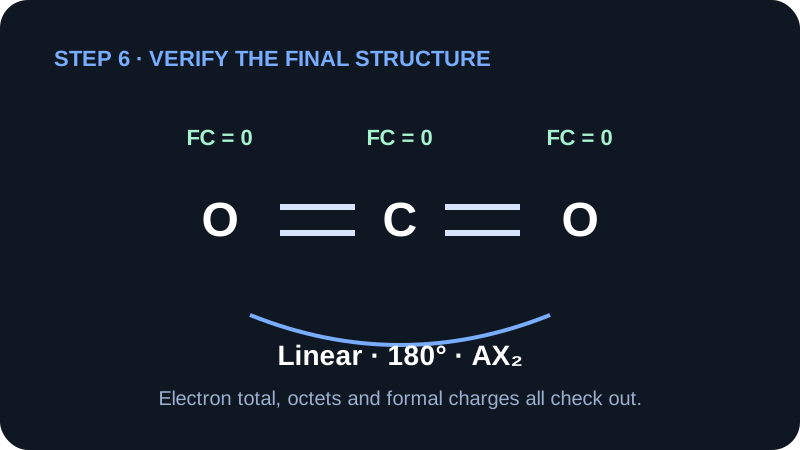
The final structure satisfies the electron total, octets, formal charges and VSEPR geometry. 6
Verify formal charges and geometry Run the final checks instead of trusting how the drawing looks. For CO₂, every atom has formal charge zero.
Formal charge = valence − nonbonding − ½(bonding electrons)16 electrons ✓ All octets ✓ Formal charges 0 ✓ Linear, 180° ✓
Final answer: CO₂ is O=C=O with two lone pairs on each oxygen and a linear molecular geometry.
Now draw one without copying Try NH₃ or H₂O using the same sequence. Generate the answer only after you finish your own electron count and skeleton.
Three checks that catch most wrong answers
1. Electron total Count every bond as two electrons and every dot as one. The total must match your original budget.
2. Octets and exceptions Second-period atoms normally need eight electrons. Remember hydrogen needs two, while BF₃, radicals, PCl₅ and SF₆ require exception rules.
3. Formal charges Prefer reasonable charge placement, minimize unnecessary charge separation and verify that all formal charges add to the overall charge.
Example: NH₃ NH₃ has 8 valence electrons. Three N–H bonds use six electrons and the last pair stays on nitrogen, producing trigonal pyramidal geometry.
Open the illustrated NH₃ guide → Example: H₂O H₂O has 8 valence electrons. Two O–H bonds use four electrons and two lone pairs remain on oxygen, producing bent geometry.
Open the illustrated H₂O guide →
When this six-step method needs extra care Resonance O₃, NO₃⁻ and SO₂ can require multiple contributors with unchanged atom connectivity.
Octet exceptions BF₃ may have an incomplete octet; radicals have odd electrons; PCl₅ and SF₆ use expanded-valence classroom models.
Formula ambiguity Organic formulas can represent multiple isomers, so a formula alone may not determine connectivity.
Continue learning Last reviewed: September 21, 2026. Educational reference only; verify graded work with course materials.