Important exception or context
With one sulfur lone pair, the electron-domain arrangement is trigonal bipyramidal. The lone pair occupies an equatorial position in the idealized VSEPR model, creating a seesaw molecular shape.
In its stated classroom Lewis model, Sulfur tetrafluoride has 34 valence electrons and Seesaw; five electron domains at sulfur (AX₄E).. See the electron-dot drawing and the counted bonds and lone pairs below.
Read the bond lines and gold lone-pair dots in the 2D picture, then use the VSEPR explanation below for the actual molecular shape.
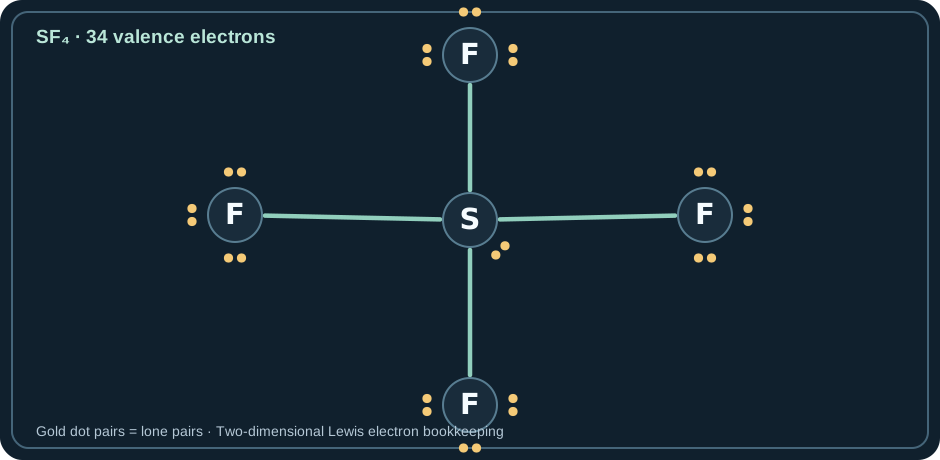
Electron cross-check: 8 bonding electrons + 26 lone-pair electrons = 34 total valence electrons. Formal charge sum: 0.
| Compound or ion | Sulfur tetrafluoride |
|---|---|
| Total valence electrons | 34 |
| Molecular shape | Seesaw; five electron domains at sulfur (AX₄E). |
| Formal charges | All formal charges 0 in the common neutral classroom drawing. |
S: 6; four F atoms: 4 × 7 = 28; total = 34.
Four S–F single bonds use 8 electrons. The four terminal fluorines each have three lone pairs (24); the remaining 2 electrons form one lone pair on sulfur. Total = 34.
The bonds and nonbonding pairs described above must use exactly 34 electrons. All formal charges 0 in the common neutral classroom drawing. Formal charge is bookkeeping; it is not always the same as a measured partial atomic charge.
Seesaw; five electron domains at sulfur (AX₄E).. Count bonding domains and central-atom lone pairs; a Lewis drawing represents electron bookkeeping, not a measured 3D structure.
With one sulfur lone pair, the electron-domain arrangement is trigonal bipyramidal. The lone pair occupies an equatorial position in the idealized VSEPR model, creating a seesaw molecular shape.
Do not confuse SF₄ (one lone pair, seesaw) with SF₆ (no central lone pair, octahedral).
Four bonds and one sulfur lone pair produce five electron domains. An equatorial lone pair leaves four visible fluorines in a seesaw arrangement.
We count valence electrons from atom identities and ionic charge, then verify bonds, lone pairs, formal charges and electron-domain geometry. The worked calculation above is original to this guide. Lewis and VSEPR models have known limits: they do not substitute for a measured structure or a full molecular-orbital treatment.
For the underlying rules, see OpenStax Chemistry 2e: Lewis Symbols and Structures and Molecular Structure and Polarity. For model boundaries, read our methodology and limitations.
Generator coverage: This is a static educational worked guide. The interactive generator maintains a separate, explicitly reviewed 110-record support registry. A molecule discussed here is not automatically available for interactive rendering. Check the supported library before using the generator.
Page last substantially reviewed: 2026-10-30.