Important exception or context
The H is bonded to oxygen, not chlorine. This distinction matters because the molecular formula is insufficient to communicate the bonding skeleton by itself.
In its stated classroom Lewis model, Hypochlorous acid has 14 valence electrons and Bent around oxygen (AX₂E₂); chlorine is terminal.. See the electron-dot drawing and the counted bonds and lone pairs below.
Read the bond lines and gold lone-pair dots in the 2D picture, then use the VSEPR explanation below for the actual molecular shape.
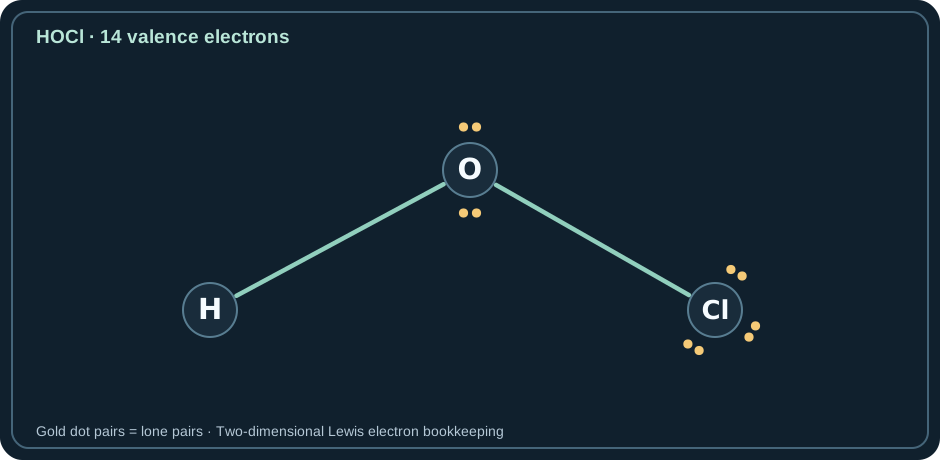
Electron cross-check: 4 bonding electrons + 10 lone-pair electrons = 14 total valence electrons. Formal charge sum: 0.
| Compound or ion | Hypochlorous acid |
|---|---|
| Total valence electrons | 14 |
| Molecular shape | Bent around oxygen (AX₂E₂); chlorine is terminal. |
| Formal charges | Formal charges 0 on H, O and Cl. |
H: 1; O: 6; Cl: 7; total = 14.
The acid connectivity is H–O–Cl, with two single bonds (4 electrons), two lone pairs on oxygen (4) and three lone pairs on chlorine (6). Total = 14.
The bonds and nonbonding pairs described above must use exactly 14 electrons. Formal charges 0 on H, O and Cl. Formal charge is bookkeeping; it is not always the same as a measured partial atomic charge.
Bent around oxygen (AX₂E₂); chlorine is terminal.. Count bonding domains and central-atom lone pairs; a Lewis drawing represents electron bookkeeping, not a measured 3D structure.
The H is bonded to oxygen, not chlorine. This distinction matters because the molecular formula is insufficient to communicate the bonding skeleton by itself.
Do not draw H–Cl–O as the standard hypochlorous-acid structure.
Oxygen has two bonds and two lone pairs. VSEPR therefore predicts bent H–O–Cl geometry rather than a straight line.
We count valence electrons from atom identities and ionic charge, then verify bonds, lone pairs, formal charges and electron-domain geometry. The worked calculation above is original to this guide. Lewis and VSEPR models have known limits: they do not substitute for a measured structure or a full molecular-orbital treatment.
For the underlying rules, see OpenStax Chemistry 2e: Lewis Symbols and Structures and Molecular Structure and Polarity. For model boundaries, read our methodology and limitations.
Generator coverage: This is a static educational worked guide. The interactive generator maintains a separate, explicitly reviewed 110-record support registry. A molecule discussed here is not automatically available for interactive rendering. Check the supported library before using the generator.
Page last substantially reviewed: 2026-10-30.