Important exception or context
Thiocyanate has two chemically distinct ends, sulfur and nitrogen. Changing a resonant bond does not reorder atoms, while ligand attachment through S versus N is a separate chemical question.
In its stated classroom Lewis model, Thiocyanate ion has 16 valence electrons and Linear at carbon (two bonding electron domains).. See the electron-dot drawing and the counted bonds and lone pairs below.
Read the bond lines and gold lone-pair dots in the 2D picture, then use the VSEPR explanation below for the actual molecular shape.
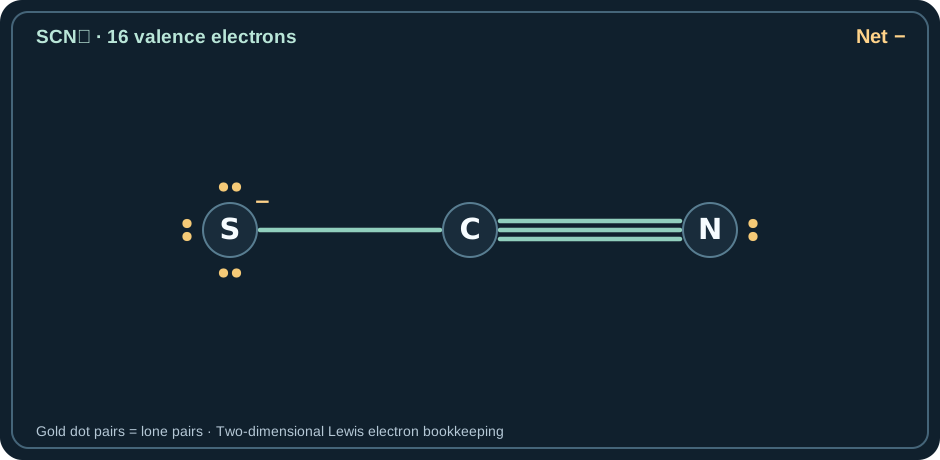
Electron cross-check: 8 bonding electrons + 8 lone-pair electrons = 16 total valence electrons. Formal charge sum: −.
| Compound or ion | Thiocyanate ion |
|---|---|
| Total valence electrons | 16 |
| Molecular shape | Linear at carbon (two bonding electron domains). |
| Formal charges | In the S⁻–C≡N contributor, sulfur bears −1 and C/N are 0; resonance can place charge on nitrogen in an S=C=N⁻ contributor. |
S: 6; C: 4; N: 5; negative charge: +1; total = 16.
One Lewis contributor is [⁻S–C≡N]⁻. The S–C single bond (2 electrons) and C≡N triple bond (6) use 8; terminal S has three lone pairs (6) and N one lone pair (2). Total = 16.
The bonds and nonbonding pairs described above must use exactly 16 electrons. In the S⁻–C≡N contributor, sulfur bears −1 and C/N are 0; resonance can place charge on nitrogen in an S=C=N⁻ contributor. Formal charge is bookkeeping; it is not always the same as a measured partial atomic charge.
Linear at carbon (two bonding electron domains).. Count bonding domains and central-atom lone pairs; a Lewis drawing represents electron bookkeeping, not a measured 3D structure.
Thiocyanate has two chemically distinct ends, sulfur and nitrogen. Changing a resonant bond does not reorder atoms, while ligand attachment through S versus N is a separate chemical question.
Do not confuse thiocyanate SCN⁻ with cyanate OCN⁻ or treat sulfur and nitrogen as identical ends.
Yes. Contributors with S–C≡N and S=C=N bonding preserve the same S–C–N skeleton and the same overall −1 charge.
We count valence electrons from atom identities and ionic charge, then verify bonds, lone pairs, formal charges and electron-domain geometry. The worked calculation above is original to this guide. Lewis and VSEPR models have known limits: they do not substitute for a measured structure or a full molecular-orbital treatment.
For the underlying rules, see OpenStax Chemistry 2e: Lewis Symbols and Structures and Molecular Structure and Polarity. For model boundaries, read our methodology and limitations.
Generator coverage: This is a static educational worked guide. The interactive generator maintains a separate, explicitly reviewed 110-record support registry. A molecule discussed here is not automatically available for interactive rendering. Check the supported library before using the generator.
Page last substantially reviewed: 2026-10-30.