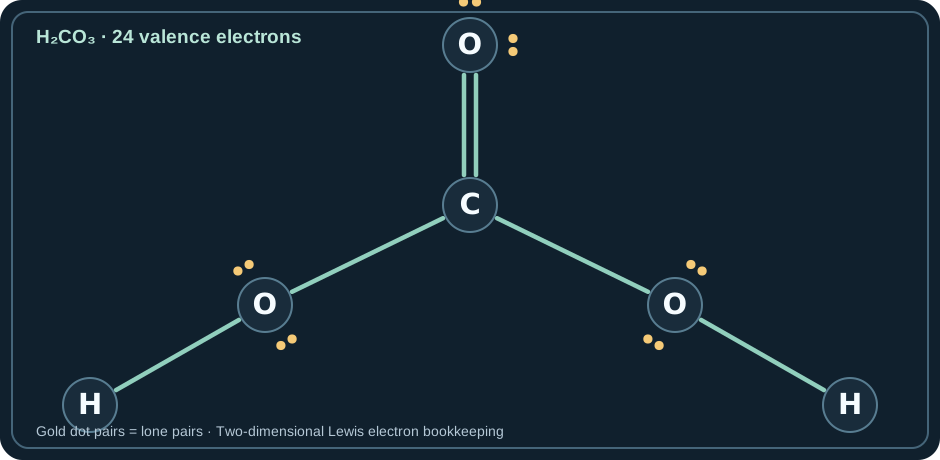
In its stated classroom Lewis model, Carbonic acid has 24 valence electrons and Trigonal planar around carbon; bent at each hydroxyl oxygen.. See the electron-dot drawing and the counted bonds and lone pairs below.
Electron cross-check: 12 bonding electrons + 12 lone-pair electrons = 24 total valence electrons. Formal charge sum: 0.
H₂CO₃ Lewis structure: quick facts
Compound or ion
Carbonic acid
Total valence electrons
24
Molecular shape
Trigonal planar around carbon; bent at each hydroxyl oxygen.
Formal charges
All formal charges 0 in the neutral carbonic-acid contributor.
How to draw the H₂CO₃ Lewis structure step by step
Count the valence electrons.
Two H atoms: 2; C: 4; three O atoms: 3 × 6 = 18; total = 24.
Choose the correct connectivity.
The H–O–C(=O)–O–H skeleton has one C=O double bond (4 electrons), two C–O singles (4), two O–H singles (4), and two lone pairs on each oxygen (12). Total = 24.
Check the electron budget and formal charges.
The bonds and nonbonding pairs described above must use exactly 24 electrons. All formal charges 0 in the neutral carbonic-acid contributor. Formal charge is bookkeeping; it is not always the same as a measured partial atomic charge.
Interpret the molecular geometry.
Trigonal planar around carbon; bent at each hydroxyl oxygen.. Count bonding domains and central-atom lone pairs; a Lewis drawing represents electron bookkeeping, not a measured 3D structure.
Important exception or context
The hydrogens belong on the two hydroxyl oxygens, not on carbon. Carbonic acid in water participates in equilibria with dissolved CO₂, bicarbonate and carbonate; a molecular Lewis drawing does not capture that entire equilibrium.
A common drawing mistake
Do not draw H₂CO₃ with both hydrogens attached directly to carbon.
Frequently asked question
Where are the hydrogens placed in a carbonic acid Lewis structure?
Each H is attached to an oxygen in a C–O–H group; the third O is connected through a C=O double bond.
Teaching method and sources
We count valence electrons from atom identities and ionic charge, then verify bonds, lone pairs, formal charges and electron-domain geometry. The worked calculation above is original to this guide. Lewis and VSEPR models have known limits: they do not substitute for a measured structure or a full molecular-orbital treatment.
Generator coverage: This is a static educational worked guide. The interactive generator maintains a separate, explicitly reviewed 110-record support registry. A molecule discussed here is not automatically available for interactive rendering. Check the supported library before using the generator.